
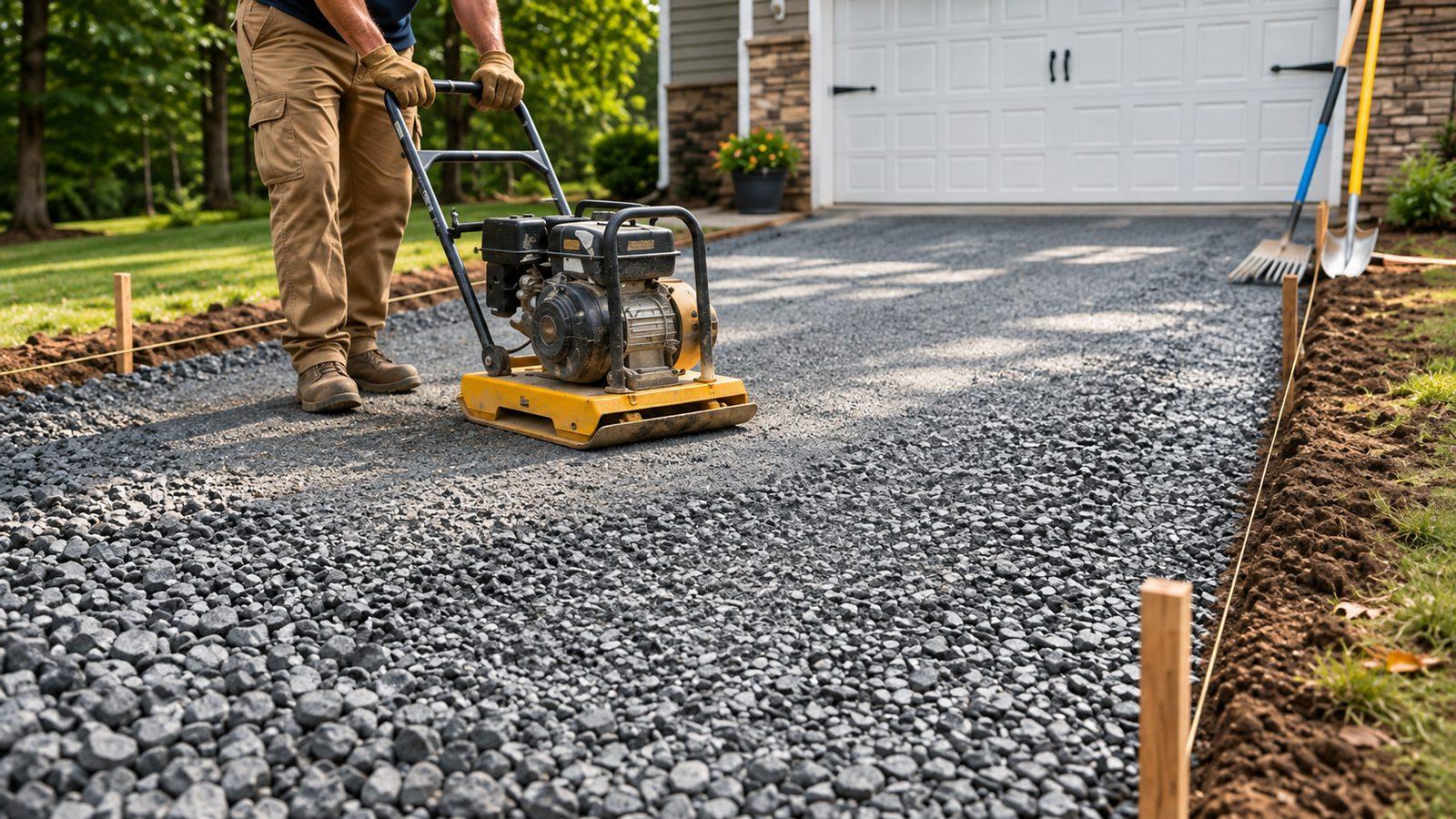
A driveway that develops ruts after every rain usually has a problem below the surface. The right road base, installed and compacted properly, creates a firmer foundation for driveways, access roads, parking areas, and patios.
In Central Texas, crushed limestone is a common choice because it is widely available, angular, and suitable for compacted base applications.
At Round Rock Landscape Supplies™, we carry limestone road base and screenings at our Leander yard. This guide explains the differences between the materials, how they compare with regular gravel, how much to order, and what to consider before starting your project. We offer bulk material pickup in Leander and delivery throughout Round Rock, Cedar Park, Georgetown, Liberty Hill, Austin, and surrounding communities.
What Is Road Base Gravel?
Road base is a mixture of crushed aggregate in different particle sizes, often including fine material that helps it compact into a relatively dense, stable layer.
Unlike clean decorative gravel, which has more open spaces between stones, properly graded road base is designed to lock together under compaction.
Road base is commonly used for:
- Gravel driveway foundations
- Ranch roads and private access roads
- Parking areas and equipment pads
- Foundations beneath patios and pavers
- Walkways and other compacted surfaces
- Site preparation and general grading
The right material depends on what you are building, the weight it needs to support, drainage conditions, and the soil underneath.
Limestone Road Base Products We Carry
Round Rock Landscape Supplies™ offers two limestone base materials suited to different applications.
| Product | Description | Common Uses |
|---|---|---|
| Limestone Road Base 1¾" Minus | Crushed limestone containing particles up to approximately 1¾ inches, along with smaller material | Driveways, access roads, and compacted base layers |
| Limestone Road Base Screenings | Fine limestone material used in compacted base and leveling applications | Fine base layers and appropriately specified bedding or leveling work |
Both materials are listed in our Gravel & River Rocks product catalog, sold in bulk by the cubic yard or by the bag. Pricing is quoted when you order.
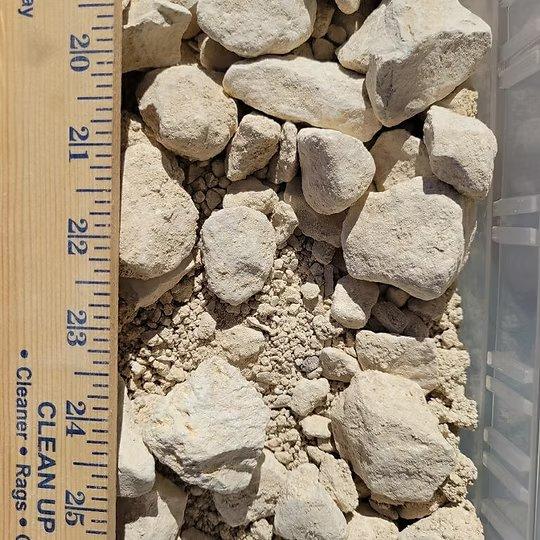
Limestone Road Base 1¾" Minus
For projects requiring a substantial compacted aggregate foundation, our Limestone Road Base 1¾" Minus is the first product to consider.
The combination of larger crushed limestone particles and smaller material helps create a mechanically interlocked base when properly installed. Typical applications include rural driveways, private access roads, and foundations beneath finished gravel surfaces.
For a new driveway, the required base thickness depends on soil conditions, expected traffic, drainage, and the overall design.
Best for: Driveways, access roads, and compacted structural base applications, subject to the project's specifications.
Limestone Road Base Screenings
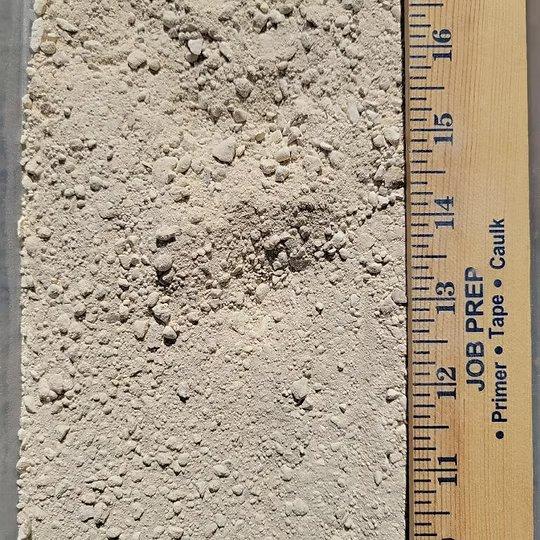
Limestone screenings are finer than the larger road base mixture.
They can be useful where a finer surface or leveling material is specified, including certain patio and hardscape installations.
Screenings should not automatically be substituted for a properly graded structural base. The two products perform different jobs.
Best for: Fine base and leveling applications where screenings are appropriate for the project design.
Need help choosing? Contact us with your project dimensions and intended use. We can help you compare available materials before ordering.
Road Base vs. Gravel: What's the Difference?
Although people often use the terms interchangeably, road base and gravel are not necessarily the same product.
Road base is selected for compaction and load support. Gravel is a broader term describing different crushed or naturally rounded aggregates.
| Material | Primary Purpose | Compaction | Drainage |
|---|---|---|---|
| Limestone road base | Stable foundations and traffic surfaces | Designed to compact | Limited permeability when densely compacted |
| Clean crushed limestone gravel | Driveways, paths, drainage, or fill, depending on size | Less binding without fines | Often more free-draining |
| Pea gravel | Landscaping, decorative surfaces, selected drainage applications | Poor interlock due to rounded shape | Water passes through open spaces |
| Decomposed granite | Pathways, patios, and landscape surfaces | Can compact with proper grading and installation | Depends on material and installation |
For most driveways requiring a compacted foundation, a properly graded road base is generally a better starting point than rounded pea gravel. Clean crushed stone may still be used as a surface course or drainage layer, depending on the design.
The limestone guide lists every crushed limestone size we stock, and the decomposed granite guide covers DG paths and patios.
What Is the Best Road Base for a Driveway in Central Texas?
Crushed limestone road base is a practical choice for many Central Texas driveways. However, the material itself is only part of the equation. The performance of a gravel driveway depends on several factors:
- Subgrade preparation: Soft soil, vegetation, and unstable material need to be addressed before placing aggregate.
- Proper drainage: Water should drain away from the driveway instead of collecting in low spots or softening the underlying soil.
- Adequate depth: Thin layers may fail under traffic, especially on weak soil.
- Compaction: The material must be spread and compacted properly to develop a stable surface.
- Traffic: A residential driveway used by passenger vehicles has different requirements from an access road carrying delivery trucks or heavy equipment.
In areas with expansive clay soils, drainage and subgrade preparation can be especially important. A driveway that repeatedly becomes muddy or develops deep ruts may need more than another load of gravel.
How Thick Should Road Base Be for a Driveway?
For preliminary residential planning, a compacted base thickness of roughly 4 to 6 inches is a common starting point for discussion. However, this is not a universal construction specification.
A project on weak or wet soil, or one supporting heavy trucks, may require a thicker base, stabilization, geotextile reinforcement, or an engineered design. The final thickness should reflect:
- Existing soil conditions
- Driveway length and slope
- Vehicle weight and traffic frequency
- Drainage and erosion exposure
- Whether another gravel or paved surface will be installed above the base
For structural pads, commercial projects, and heavily trafficked access roads, follow the engineer's or contractor's specifications.
How Much Road Base Do You Need?
Road base quantities are typically estimated using the length, width, and intended compacted depth of the area.
Road Base Calculator Formula
Cubic yards = (Length in feet × Width in feet × Depth in inches) ÷ 324
This gives the geometric volume at the specified depth.
For example, a driveway measuring 40 feet long by 10 feet wide with a planned 4-inch finished base depth requires (40 × 10 × 4) ÷ 324 = 4.94 cubic yards. That is approximately 5 cubic yards of finished material volume.
The actual loose quantity needed for delivery may be greater because of compaction, uneven grading, and material loss.
Road Base Coverage Chart
The following estimates show theoretical finished coverage before any additional loose-material or compaction allowance.
| Area | 4-Inch Depth | 6-Inch Depth |
|---|---|---|
| 200 sq. ft. | 2.47 cubic yards | 3.70 cubic yards |
| 400 sq. ft. | 4.94 cubic yards | 7.41 cubic yards |
| 600 sq. ft. | 7.41 cubic yards | 11.11 cubic yards |
| 800 sq. ft. | 9.88 cubic yards | 14.81 cubic yards |
| 1,000 sq. ft. | 12.35 cubic yards | 18.52 cubic yards |
These numbers are estimates, not guaranteed order quantities.
Before ordering, confirm whether your measurements represent loose or compacted thickness. Material gradation, moisture, and existing ground conditions can affect the quantity required.
Road Base Calculator
Enter the length and width of your driveway or pad in feet and the planned base depth in inches.
For other materials and depths, use the gravel, rock, and soil coverage calculator.
How to Install Road Base for a Driveway
A long-lasting driveway starts with preparation rather than simply dumping gravel onto the existing ground.
Step 1: Prepare the Ground
Remove vegetation, organic topsoil, and unsuitable material as needed. Correct soft spots and establish the intended finished grade.
For significant fill or weak soil, consult a qualified contractor.
Step 2: Plan for Drainage
A driveway needs appropriate slopes and outlets for surface water.
Without good drainage, water can collect beneath or beside the base and eventually lead to rutting, settlement, or washouts.
Step 3: Spread the Road Base
Place the material evenly across the prepared area.
For thicker installations, the base may need to be installed in multiple lifts rather than one deep layer. Follow the project specifications and the compaction equipment's capabilities.
Step 4: Compact the Material
Use suitable compaction equipment and the appropriate moisture conditions.
A mechanical roller or plate compactor may be appropriate depending on the project size, layer thickness, and material.
Compaction is essential. Simply driving over loose material does not necessarily produce consistent or adequate compaction.
Step 5: Check the Finished Surface
After compaction, inspect the driveway for uneven areas, drainage problems, and soft spots.
Additional surface aggregate may be used if the finished design calls for it.
For driveways with ongoing drainage or structural problems, professional evaluation can help prevent repeated repairs.
Can You Use Road Base Under Pavers and Patios?
Yes. Properly graded crushed aggregate is commonly used as a compacted foundation beneath pavers and certain patio installations. However, the required base material, thickness, bedding layer, and compaction depend on the paving system and site conditions.
A typical hardscape installation may involve:
- A properly prepared subgrade.
- A specified compacted aggregate base.
- An appropriate bedding layer.
- Pavers or patio stones.
- Edge restraints and joint material as required.
Limestone screenings may be used in some leveling or bedding applications, but they are not universally suitable for every paver system.
For material and installation comparisons, see our flagstone, patio stone & pavers guide.
Common Road Base Mistakes to Avoid
Adding Gravel Without Addressing Drainage
If water consistently collects on a driveway, spreading another layer of material may temporarily improve its appearance without correcting the underlying issue.
Using the Wrong Aggregate
Smooth pea gravel and clean decorative rock do not compact the same way as a graded road base with fines.
Choose material according to the job rather than appearance alone.
Skipping Compaction
Road base needs proper compaction to develop a firm, stable foundation. Loose aggregate may shift and develop ruts under repeated traffic.
Ordering Without Measuring
A small difference in driveway depth can significantly change the material quantity.
Measure the length and width, determine the required base thickness, and confirm your ordering allowance before scheduling delivery.
Ignoring the Existing Soil
Weak or saturated soil can cause even a well-compacted aggregate layer to fail.
Base thickness, drainage improvements, and soil stabilization should be evaluated together.
Road Base Delivery in Leander, Round Rock & Austin
Round Rock Landscape Supplies™ provides bulk limestone road base and other landscape materials from our yard in Leander, Texas. We serve homeowners, landscapers, builders, and contractors throughout:
- Leander
- Round Rock
- Cedar Park
- Georgetown
- Liberty Hill
- Austin
- Surrounding Central Texas communities
Road base and other loose bulk materials go out by dump truck. Delivery is quoted per order based on the distance from our Leander yard and the truck your material needs. We'll confirm the delivery fee for your address when you order. Same-day and next-day delivery is often available.
We can deliver and dump only one material at a time, in a single spot, on a cleared, accessible driveway. Delivery placement is subject to site access and driver safety. Read our bulk material delivery information for additional details.
You can also pick up material at our Leander yard:
Round Rock Landscape Supplies™600 N Bagdad Rd
Leander, TX 78641
Yard hours: Monday – Friday 8:00am – 4:00pm, Saturday 8:00am – 12:00pm, closed Sunday