
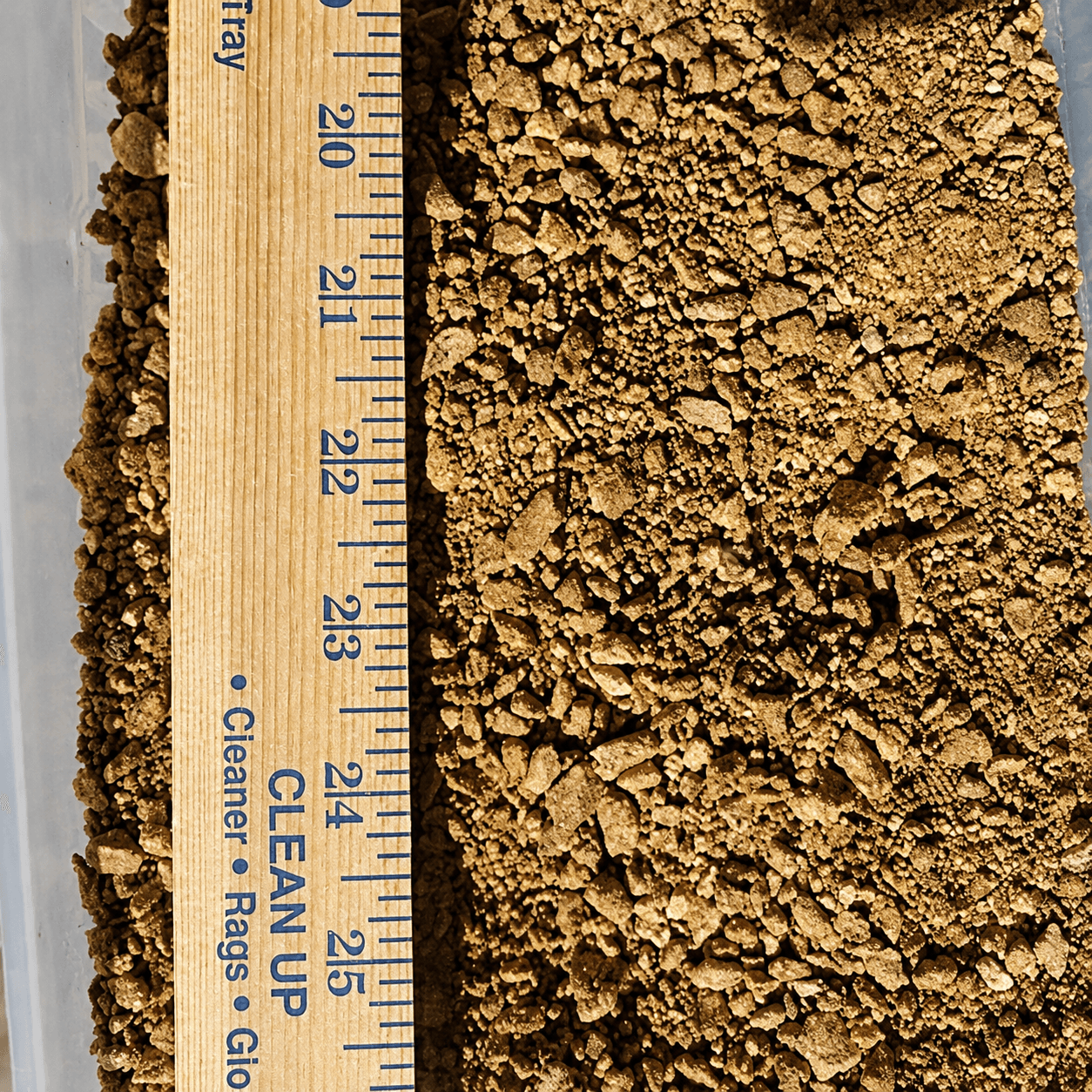
Drive through any neighborhood in Leander, Round Rock, or Austin and you will see decomposed granite everywhere. It lines garden paths, fills patio seating areas, borders xeriscaped front yards, and covers everything from dog runs to driveways. There is a reason it has become the signature landscape material of the Texas Hill Country: it looks natural, it handles our heat and drought without complaint, and it costs a fraction of what pavers or concrete run.
This guide covers what decomposed granite actually is, the colors and types we carry, the difference between loose and stabilized DG, how to install it so it lasts, and how to figure out exactly how much you need.
What Is Decomposed Granite?
Decomposed granite, usually shortened to DG, is granite rock that has naturally weathered and broken down into a mix of small gravel, sand, and fine particles. Those fines are what make DG special. When the material is spread, wetted, and compacted, the fines bind the larger particles together into a firm, stable surface that feels closer to a natural trail than a bed of loose gravel.
That firmness is what separates DG from materials like pea gravel. Pea gravel stays loose and shifts underfoot forever. Properly compacted DG firms up into a walkable, wheelbarrow friendly, even stroller friendly surface while still letting rainwater soak through into the soil below.
DG is typically screened to 1/4 inch minus or 3/8 inch minus, meaning every particle is that size or smaller, fines included. If you have walked a trail in a Texas state park or crossed the grounds of a winery in the Hill Country, you have almost certainly walked on it.
Decomposed Granite Colors
Because DG is a natural material, color comes from the granite it weathered from, and Central Texas is fortunate to sit near some of the best granite in the country.
- Gold and tan - The classic Texas look. Warm buff and gold tones that pair naturally with limestone homes, cedar fencing, and native plantings. This is the most popular choice for paths and patios across the Austin area.
- Pink - Sourced from the same Hill Country granite that built the Texas State Capitol. Pink DG has rosy and salmon tones that stand out beautifully against green plantings and gray stone.
- Gray - A cooler, more contemporary look that works well with modern architecture, steel edging, and white limestone.
Colors vary from load to load because this is natural stone, not a manufactured product. If an exact shade matters for your project, visit our yard in Leander and look at the current stock in person before ordering.
Loose vs Stabilized Decomposed Granite
This is the decision that matters most, and it comes down to how the surface will be used and how much maintenance you want to do.
- Loose DG is the raw material, delivered as is. Spread it, wet it, compact it, and the natural fines will bind it into a reasonably firm surface. It is the most affordable option and the easiest to install. The tradeoff is that loose DG slowly sheds material over time. Heavy rain can wash fines out, high traffic loosens the surface, and most loose DG installations want a fresh top layer every year or two. For garden beds, tree rings, low traffic paths, and areas protected from runoff, loose DG is usually all you need.
- Stabilized DG is decomposed granite blended with a binding agent, typically a natural, plant based stabilizer that activates with water. Once installed and compacted, stabilized DG cures into a much harder, more durable surface that resists erosion, sheds far less dust and loose material, and holds up under regular foot traffic and weather. It costs more per yard and the installation is less forgiving, but for main walkways, patios, courtyards, and any surface that sees daily use, stabilization is worth it.
A good rule of thumb: if people will walk on it every day or if water flows across it when it rains, stabilize it. If it is decorative ground cover or a casual garden path, loose DG will serve you well.
One thing stabilized DG is not: waterproof pavement. Even stabilized, DG remains a permeable, natural surface. It is not the right material for surfaces that need to stay pristine under vehicle traffic combined with standing water. For driveways, see the section below.
What Does Decomposed Granite Cost?
DG is sold by the cubic yard and remains one of the most economical hardscape materials available, typically a small fraction of the installed cost of flagstone, pavers, or concrete covering the same area. Loose DG costs less than stabilized, and buying in bulk by the yard is dramatically cheaper than buying bagged material from a big box store.
Prices change with fuel and quarry costs, so call or text us at (512) 260-9273 for current per yard pricing, or stop by the yard at 600 N Bagdad Rd in Leander. We will also help you estimate quantities so you buy the right amount the first time.
Common Uses for Decomposed Granite
- Garden paths and walkways. The most popular use. A 2 to 3 inch layer of DG over compacted ground, contained with steel or stone edging, creates a natural looking path that stays firm underfoot.
- Patios and seating areas. DG makes a beautiful, budget friendly patio surface, either wall to wall or as the joint filler between flagstone. For patios that host furniture and daily use, go with stabilized DG at 3 to 4 inches over a compacted base.
- Xeriscaping and ground cover. DG is a cornerstone of Central Texas xeriscapes. It replaces thirsty turf, suppresses weeds when installed over a proper base, and keeps its looks through drought and watering restrictions.
- Driveways. DG driveways can work in the right conditions, but they demand more: a 4 to 6 inch total depth installed in compacted layers over a solid base, stabilizer strongly recommended, and realistic expectations about ruts and periodic touchups under vehicle weight.
- Dog runs and play areas. DG drains quickly, stays cooler than many surfaces, and is easy to rake clean.
- Trails and larger properties. For acreage, DG is the standard for building natural surface trails that hold up to weather.
How to Install Decomposed Granite
A DG path or patio is a very achievable DIY project. The difference between a surface that lasts ten years and one that washes out next spring is almost entirely in the preparation and compaction.
- 1Excavate and grade. Dig out the area to allow for your full DG depth, typically 3 inches for paths and 4 inches for patios. Grade a slight slope, about 1 to 2 percent, away from structures so water sheds rather than pools.
- 2Compact the subgrade. Compact the exposed soil with a plate compactor. A soft subgrade guarantees a soft surface.
- 3Install edging. DG needs containment or it will migrate. Steel edging gives the cleanest lines, or use chopped limestone or stone borders for a more natural Hill Country look. We stock both.
- 4Spread in lifts. Never dump the full depth and compact once. Spread DG in layers no more than 1.5 to 2 inches at a time.
- 5Wet each lift. Lightly and evenly water each layer. For stabilized DG, follow the stabilizer's water activation instructions closely, since moisture is what triggers the binder to cure.
- 6Compact each lift. Run the plate compactor over each moistened layer until it is firm before adding the next. This layered approach is what builds a dense, unified surface.
- 7Cure. Keep traffic off the finished surface for 48 to 72 hours, longer for stabilized DG per the binder instructions.
You do not need to own any of this equipment. We rent plate compactors and the tools to move material right from our yard, so you can pick up your DG and the compactor in one trip.
How Much Decomposed Granite Do I Need?
DG quantities are figured in cubic yards. The math is simple:
At common depths, one cubic yard of DG covers approximately:
| Depth | Coverage per cubic yard |
|---|---|
| 2 inches | ~162 sq ft |
| 3 inches | ~108 sq ft |
| 4 inches | ~81 sq ft |
So a 4 foot wide path running 50 feet at 3 inches deep needs roughly 2 cubic yards. Order about 10 percent extra to account for compaction and settling, since DG compresses as you compact it.
For an exact figure, use our material coverage calculator, or call us with your dimensions and we will run the numbers with you.
One planning note: a cubic yard of DG weighs roughly 1.4 tons, so a small pickup can typically haul about half a yard safely. For most projects, delivery is the practical choice. We deliver DG by the truckload across Leander, Round Rock, Cedar Park, Georgetown, Austin, and the surrounding area, often same day or next day. See our delivery page for details.
Decomposed Granite vs Crushed Granite vs Pea Gravel
These three get mixed up constantly, and the differences matter.
- Decomposed granite vs crushed granite. Crushed granite is mechanically crushed rock with sharper, more angular pieces and fewer fines. It stays looser and crunchier underfoot and is often used decoratively or for drainage. Decomposed granite, with its natural fines, compacts into a firmer surface, which is why DG is the choice for paths and patios while crushed granite leans decorative.
- Decomposed granite vs pea gravel. Pea gravel is small, rounded stone with no fines at all. It never firms up, always shifts underfoot, and migrates out of its area without deep edging. It drains extremely well and has a distinct polished look, which keeps it popular for accents, drainage zones, and playgrounds. But for any surface you actually walk on regularly, compacted DG is the more comfortable and stable choice.
Why DG Is the Right Material for Central Texas
Our climate is hard on landscapes. Long stretches of triple digit heat, drought and watering restrictions, then sudden downpours that dump inches of rain in an afternoon. Decomposed granite is built for exactly this. It never needs watering, it lets storm runoff soak through instead of sheeting off, it does not fade or crack in the sun, and its warm natural tones look like they belong next to limestone and live oaks because they come from the same landscape.