
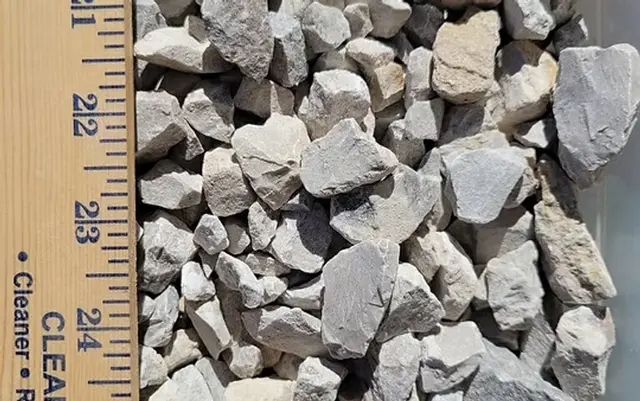
River rocks are the most requested material at our Leander yard after decomposed granite. This guide covers the types we stock, which size fits which project, common river rock landscaping uses, and how to estimate your order for pickup or delivery in Austin, Round Rock, Cedar Park, Georgetown, and Liberty Hill.
What River Rock Is
River rock is stone that has been rounded and smoothed by moving water, either pulled from river beds or tumbled to match. That is the difference from gravel, which is crushed and has sharp edges. Smooth edges are why river rock is used where people see it up close: dry creek beds, drainage swales, borders, and as a long-term mulch alternative around trees and beds.
It does not compact, so it stays loose underfoot. That makes it a poor choice for paths or driveways. For a walkable surface, use decomposed granite instead.
River Rock We Carry
Availability changes with what is in the yard. Pricing is quoted when you order. See the full lineup on the Gravel & River Rock page.
| Type | Look | Sizes | Best for |
|---|---|---|---|
| Austin River Rock | Local Texas stone, tan, gray, and brown earth tones | 5/8" to 1", 1¼", 1" to 2", 2" to 4" | Dry creeks, beds, drainage on a budget |
| Brazos River Rock | Smooth, rounded, mixed neutrals from the Brazos basin | 1" to 2", 2" to 4", 3" to 5" | Creek beds and borders where you want larger, uniform stone |
| Peach Cobble (Santa Fe) | Warm peach and salmon tones | 1" to 2" | Southwest and xeriscape designs |
| Llano River Rock | Hill Country stone with strong color variation, reds and pinks mixed in | 1", 1" to 2", 2" to 4", 4" to 6" | Feature beds and creek beds where the rock is the focal point |
| Arizona River Rock | Desert reds, tans, and grays | ¾" to 1½", 1" to 3" | Accent areas where color matters more than coverage |
| Colorado Rainbow | Bright multi-color, blues, greens, purples | 1" to 2", 2" to 4" | Small accent areas, water features, planters |
Austin River Rock is the value pick and what most homeowners use for large areas. Llano is the local premium option and the one people ask for by name. Arizona and Colorado Rainbow are premium imports, so they make sense for small accent zones, not a 500 square foot bed.
We also carry Black Lava Rock by the bag and several beach pebbles (black, buff, button, and candy) for polished accents.
River Rock Sizes and What They Are For
Size is the decision that affects how the finished project looks and how well it works.
- 5/8" to 1" - Small enough to fill gaps between pavers, top off planters, and cover beds where you want a fine texture. Too small for drainage channels that carry real water flow.
- 1" to 2" - The all-purpose size. Works for bed cover, borders, around tree rings, and the bottom of a dry creek bed. If you are not sure, start here.
- 2" to 4" - The standard size for dry creek beds and drainage swales. Heavy enough to stay put during a hard Central Texas rain.
- 3" to 6" - Cobble size. Used along the edges of a creek bed to frame the smaller stone, or on slopes where anything lighter would wash downhill.
For a natural-looking dry creek, mix at least two sizes: larger stone along the edges and at bends, smaller stone through the center. Add a few boulders at the curves to anchor it.
How Much You Need
River rock is sold by the cubic yard. Use this formula:
Recommended depth by size:
| Rock size | Depth |
|---|---|
| Under 1" | 2 inches |
| 1" to 2" | 2 to 3 inches |
| 2" to 4" | 3 to 4 inches |
| 3" to 6" | 4 inches or one layer |
Larger stone needs more depth or the ground shows through. A 10 ft by 30 ft dry creek bed at 3 inches deep is about 2.8 yards; round up to 3.
A cubic yard of river rock weighs roughly 2,500 to 2,800 pounds. A half-ton pickup hauls about half a yard. Anything more than a yard, have it delivered.
For other shapes and depths, use the coverage calculator.
Installing It So It Lasts
- 1Remove grass and weeds down to bare soil.
- 2Grade the area so water moves where you want it. For a dry creek, dig a shallow channel 6 to 12 inches deep with sloped sides.
- 3Lay landscape fabric and pin it. This is what keeps rock from sinking into the soil and weeds from coming up through it.
- 4Set edging or larger stones along the borders first.
- 5Spread the smaller rock and rake it level.
- 6Rinse it with a hose. River rock arrives dusty and looks completely different once clean.
Skip the fabric and you will be topping off the bed in two years as the rock disappears into the dirt.
River Rock Landscaping: Mulch, Beds, and Dry Creeks
River rock mulch is a common replacement for wood mulch in Central Texas because it does not decompose, blow away, or wash out. The tradeoffs: it holds heat, so keep it a few inches off trunks and stems, and it does not feed the soil the way organic mulch does. It works best around established trees, in xeriscape beds, and along foundations where you want a clean, permanent finish. It is a poor fit for vegetable beds and anything you replant often.