
Most people ordering bulk material for the first time have the same three questions. How much is a yard, really? Will it fit in my driveway? And what is this going to cost once the truck actually shows up? Fair questions, and worth answering before you pick up the phone.
This guide walks through how bulk material is measured and sold, how much fits in a truck load, what a yard of common materials weighs, what it covers on the ground, and how delivery is quoted. By the end you should be able to plan an order with confidence instead of guessing.
How Bulk Material Is Sold
Bulk landscape material is priced and measured by the cubic yard. One cubic yard is 27 cubic feet, roughly a cube three feet tall, three feet wide, and three feet deep. If you have ever loaded a wheelbarrow, one cubic yard works out to about nine full wheelbarrow loads.
Compare that to the bagged material at a big box store. A standard bag holds 2 cubic feet, so one cubic yard replaces roughly 13 to 14 of those bags. Once a project needs more than a bag or two, buying in bulk is almost always cheaper and a lot less hauling.
How Much Fits in a Truck Load
Here is how load sizes break down, from a small truckload project up to a full truck:
| Load size | Cubic yards | Typical use |
|---|---|---|
| Small load | 1 to 4 yards | Flower beds, a small patio base, topdressing a lawn |
| Medium load | 5 to 14 yards | Front yard rock beds, a driveway base, a full mulch refresh |
| Full dump truck load | 15 to 19 yards | Whole-yard projects, new construction, large fill jobs |
| Flatbed | Pallets and bags | Palletized stone and bagged products |
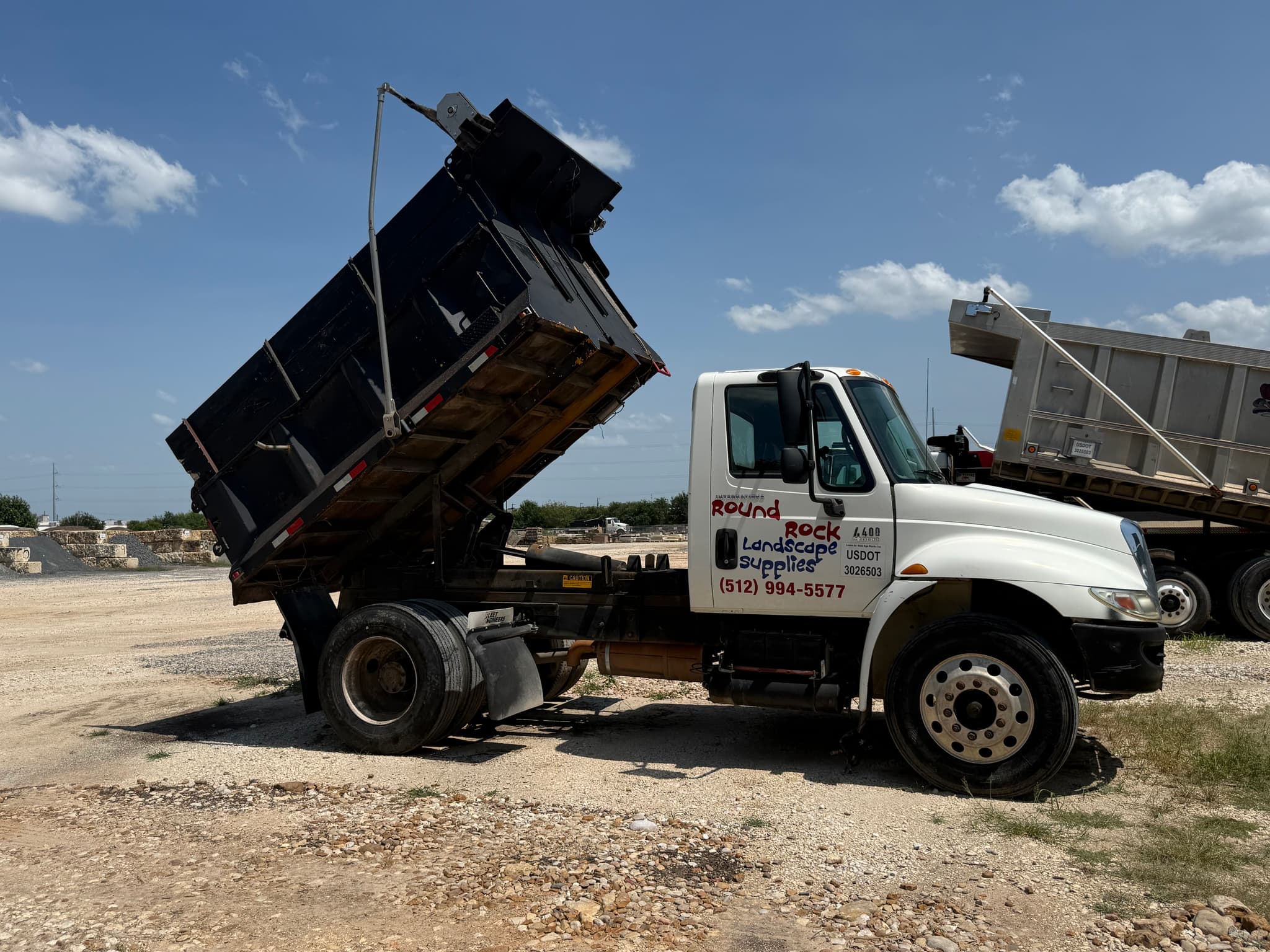
Heavier materials cap out by weight before they cap out by volume. That is why a full load runs closer to 15 yards on something dense like gravel or decomposed granite, and closer to 19 yards on something light like mulch. Delivery is quoted per order by distance and truck type.
What a Cubic Yard Weighs
These are approximate weights. Moisture content changes the actual weight of any load, so treat these as planning figures rather than exact numbers.
| Material | Approx. weight per cubic yard |
|---|---|
| Mulch | 400 to 800 lbs |
| Compost | 1,000 to 1,400 lbs |
| Garden soil / topsoil | 1,800 to 2,200 lbs |
| Sandy loam | 2,000 to 2,400 lbs |
| Fill dirt | 2,000 to 2,700 lbs |
| Sand | 2,600 to 3,000 lbs |
| Gravel and river rock | 2,600 to 3,000 lbs |
| Decomposed granite | 2,700 to 3,000 lbs |
| Road base / flex base | 2,800 to 3,200 lbs |
What One Yard Covers
Coverage depends on depth. As a rule of thumb, 2 inches is standard for topdressing mulch, 3 inches works for most rock beds, and driveways or high-traffic paths want 4 inches or more.
| Depth | Coverage per cubic yard |
|---|---|
| 1 inch | 324 sq ft |
| 2 inches | 162 sq ft |
| 3 inches | 108 sq ft |
| 4 inches | 81 sq ft |
| 6 inches | 54 sq ft |
Need to run the numbers for your exact project? Use our coverage calculator to turn your measurements into cubic yards.
How Delivery Is Quoted
Delivery is quoted per order. Two things set the fee: the round-trip distance from our Leander yard to your address, and the type of truck your material needs. Loose bulk material goes out on a dump truck; pallets and bagged products go out on a flatbed. Send us your material, quantity, and address, or call, and we will confirm the delivery fee before anything is scheduled. The delivery page covers each city we serve.
Delivery fees are confirmed at the time of your order. Not sure whether we reach your address? call (512) 260-9273.
One delivery fee covers one truck load, so on most orders buying slightly more than the bare minimum costs less than paying for a second delivery later.
Prepping for a Delivery
A little prep before the truck arrives keeps things simple:
- 1Measure your area and pick a depth. Figure out square footage and how deep you want the material. Use our coverage calculator if you need help turning that into cubic yards.
- 2Clear the driveway completely. Move vehicles, trim low branches, and clear anything else out of the drop path. A blocked driveway means the driver cannot unload.
- 3Pick one drop spot. We can dump one material in one spot per delivery. Decide ahead of time where that pile needs to land.
- 4Confirm someone will be on site. Have someone available during the delivery window, or mark the drop spot clearly with cones or paint so the driver knows exactly where to go.
- 5Have a tarp ready if rain is coming. Covering a fresh pile before a storm saves you from washout and keeps material from spreading where you do not want it.
A note on driveway load limits
A loaded dump truck can weigh 40,000 pounds or more, and standard residential concrete is not always rated to handle that. Talk to us about placement before you order, especially on older concrete, pavers, or a steep driveway approach, so we can plan a spot that works.
A few policies apply to every delivery, no exceptions:
- We deliver to driveways only. We do not drop material at the curb or street.
- One material at a time, in a single spot, per delivery.
- The driveway must be cleared before the delivery window. If it is not, the driver cannot unload.
- Delivery is at the driver's discretion, for the safety of the driver and the equipment.
- We are not responsible for damage that occurs while loading or delivering material.
- The customer assumes responsibility for material spillage on roads.
- We do not accept cash payments.
See our full delivery disclaimers and store policies for complete details.
Delivery by Material Type
We deliver everything we stock, in dump trucks for bulk material and flatbeds for palletized stone and bagged products.
- Gravel and river rock: Crushed limestone, pea gravel, and river rock for beds, paths, and drainage.
- Compost, mulch, and soil: Topsoil, compost blends, and mulch for beds, lawns, and new plantings.
- Decorative stone: Mexican beach pebbles, marble chips, and other decorative accents.
- Boulders and stone: Accent boulders and feature stone, sold by the ton and delivered by flatbed.
- Cement and base materials: Bagged cement, sand, and base materials for concrete and hardscape work.
Fill Dirt vs Select Fill vs Sandy Loam vs Garden Soil
These four get mixed up constantly, and the right one depends entirely on what you are doing with it.
- Fill dirt
- Raw, unscreened soil used to raise or fill low areas. It can contain rocks, clay, and debris, and it is not meant for growing anything.
- Select fill
- A cleaner, more consistent fill material, screened to remove large rocks and debris. It compacts more predictably than raw fill dirt, which matters for grading and base work.
- Sandy loam
- A blended topsoil with enough sand content to drain well. Commonly used as a base layer under new sod or for leveling a yard before planting.
- Garden soil
- The richest of the four, amended with organic matter and built for planting beds, vegetable gardens, and anywhere you actually want things to grow.
Where We Deliver
We deliver throughout Central Texas from our yard in Leander:
- Leander (our home base)
- Cedar Park (about 8 miles)
- Liberty Hill (about 12 miles)
- Round Rock (about 18 miles)
- Georgetown (about 22 miles)
- Austin (about 25 miles)
The flat-rate table above covers up to 35 miles round trip. Anything beyond that is quoted individually, just give us a call.
Would rather skip delivery entirely? You can pick up at our yard at 600 N Bagdad Rd in Leander during business hours (Monday to Friday 7:30am to 4:00pm, Saturday 8:00am to 12:00pm, closed Sunday). We also rent a cart (7 cubic feet) or trailer (3.5 yards / 4 tons) if you need to haul it yourself. See equipment rental for details.